-
 • 10/19/26
Designing for an Unreal World: Research, Labor, and Herman Miller’s Action Office
Introduced to the market in 1968, Herman Miller’s Action Office II system promised to revolutionize the office furniture and office architecture industries by adding humanity, flexibility, and integrating sophisticated technology into spaces previously ignored by architects and designers. Such optimism, however, was not to last long. Twenty-five years after the system’s launch, Action Office was widely understood as the progenitor of the dreaded, dreary, uniform, and inflexible cubicle style of office interior (Kauffman-Buhler, 2021; Haigh, 2012; Duffy, 1997). How can this discontinuity between the well-meaning intention of Action Office and the negative spatial realities the system eventually brought about be understood? To date, the literature has suggested that the transformation of Action Office into the cubicle occurred after the system’s widespread adoption; that the cubicle’s most hated features came about as the result of individual bad actors (corporations and managers), and fault in this process lies outside of Herman Miller’s walls (Saval, 2014).
Finding such explanations fall short of convincing, this paper locates the ‘problems’ with Action Office in the system’s founding principles, in the research and development methods employed, and in the Herman Miller Furniture Company’s broader approaches to labor relations. Drawing on Marxian labor process theory (Braverman, 1974), it argues that through mobilization of corporate conceptions and design processes which did not reflect the reality of monopoly capital, Herman Miller and Propst created a system which was set up from the start to fail, and which could be easily moulded to meet the (inhumane) fundamental and operational needs of capitalism
This video is a recording of a paper delivered to the 2026 North American Labor History Conference, held at Wayne State University.
-
• 9/29/26
Largely Unremarkable: Insights on Office Architecture from a Mid-Sized, Midwestern American Technology Firm
While the expensive, expansive, and amenity-laden white-collar workspaces of contemporary technology giants frequently make the news for extravagant additions, starchitect designed architectural features, and corporate workplace policies, the more mundane office spaces of small- and medium-sized white-collar corporations have received little attention - either popular or scholarly. Architectural histories of the office are frequent offenders of this practice, narrating a consistent history which travels from Frank Lloyd Wright’s Larkin Administration Building (1904) to the buildings of prominent mid-century Modernists (Eero Saarinen, Mies van der Rohe, Gordon Bunshaft) and firms (Skidmore, Owings, and Merrill), ending with more contemporary, yet still famous examples by Gaetano Pesce (Chiat/Day Headquarters, 1995), Frank Ghery (Facebook’s MPK20, 2015), and Norman Foster (Apple Park, 2017)(Duffy 1997; Haigh 2012; Saval 2014; Liming 2020). From this consistent and eminent sample of buildings, authors frequently conclude that the history of office architecture is one of positive evolution; with spaces becoming more functional, productive, and comfortable over time (Horgan 2021; Jacques 1996; Shaiken 1986). While a compelling narrative, the often-told history of the office largely does not explore the more pedestrian, average office spaces used day in and day out by the majority of white-collar workers.
Doctoral research conducted immediately following the height of the COVID pandemic on an American Midwestern, mid-sized technology company undergoing an office renovation project sought to begin filling this gap. Through interviews with company executives, contracted architects, and rank-and-file employees across a variety of departments, previously asserted realities of commercial office work were both confirmed and refuted, and additional insights regarding the architect/client relationship were uncovered.
Drawing upon the findings of case study research, this paper highlights four insights into the architecture, experience, and labor relations of the pedestrian contemporary office:
1) The omnipresent and unquestioned logic of capital throughout the office design ecosystem, from architects and interior designers to corporate executives.
2) Substantiation of claims regarding some benefits of in-person working.
3) The importance of employee control over working environments.
4) The significance of past office/workplace experience on current worker satisfaction and future expectations.
These findings, it is suggested, both help to explain why commercial office spaces are (as horrible) as they are and provide important conceptual and practical foundations toward the imagination and creation of better, more comfortable, more pleasant, more human white-collar workspaces in the future.
-
 • 9/29/26
A Chair is a Chair is a Chair is a Chair: Use-based Furniture History as an Anti-Colonial Technique
Designed to furnish the planned post-independence capital of the Indian Punjab, modernist furniture from the city of Chandigarh has taken the world by storm. From the pages of The New York Times and Wall Street Journal to dentist’s offices and restaurants in New York, and from Kim Kardashian and Kanye West’s Calabasas mansion to prints on designer clothing, the bulky, angular forms of Chandigarh’s modernist furniture are now hard to miss. Popular narratives of the furniture, told in glossy full-color coffee table books and re-told by the design and popular press highlight the pieces’ design by Pierre Jeanneret, the supposed ‘neglect’ of this furniture by Chandigarh residents and government officials, and the ‘saving’ of Chandigarh’s modern design heritage by French dealers and wealthy design collectors. As a result of this narrative, these now iconic objects have been transformed from Chandigarh Chairs to “Jeanneret Chairs,” from utilitarian furniture to pieces of high design, and from embodiments of Indian design to items residing solidly in the European modernist design canon (Seitz et.al, 2022).
Understanding such effects to be harmful, this paper proposes leveraging histories and realities of use as a tool to build more truthful and resolutely anti-colonial histories and present realties of designed objects (Feldman, 2024; Henderson, 2020). By detailing, emphasizing and encouraging normal day-to-day use of Chandigarh’s furniture we can undermine suggestions that Chandigarh’s residents have not appropriately appreciated the city’s furniture, help ensure that those for whom these pieces were created maintain access to them, and aid in the recategorization of Chandigarh’s modernism as a part of Indian – not European – design history (Holtorf and Bolin, 2024; Fekrsanati and Marçal, 2022).
-
• 9/29/26
A More Perfect Union: A Labour Process Theory Reevaluation of Partnerships in Workplace Research
Corporate management has long loomed large in academic exploration of the workplace. It is corporate management which commissions architects and designers in their work, and which provides final approval on designs. Management facilitates or allows scholars access to workspaces and employees, and occasionally subsidizes workplace research. Such managerial involvement has become both ubiquitous and unnoticed – a standard operating procedure in the field.
Grounded in the insights of Marxian labour process theory (Braverman 1974) this paper problematizes the researcher/management and architect/manager relationship. It suggests that managerial involvement in office research and design has impacted how office research is conducted, as well as how such spaces are broadly constituted and understood. Potential impacts of management-exclusive or management-dominated research partnerships are discussed along two lines: structural impacts upon study and workspace design, and conceptual impacts on how workplaces and work are understood. Turning again to labour process theory, the paper suggests potential counterbalances and solutions to the status quo including increasing research partnerships with organized labour/unions, interdisciplinary research methods, and explicit identification of managerial relationships as a research method.
-
 11/20/25
The $300,000 Table
In a 2011 Phillips auction a table from the library of the Punjab University was sold as the work of French-Swiss architect Pierre Jeanneret for over $300,000 USD. This auction was an almost unconceivable event – a piece of utilitarian municipal furniture, used by generations of university students, selling at an international auction for more than the price of a house in the city of its origin.
Employing the case study of modernist furniture from the Northern Indian city of Chandigarh, this paper outlines the systemic culture and environment of the trade in high-end objects of design. It begins to unpack and explore the networks of auction houses, antiques dealers, wealthy collectors, and journalists working, sometimes unwittingly, behind the scenes to influence our understandings of designed objects. The paper outlines how some elements of the history of Chandigarh’s modernist furniture which have value to predominantly white, Western, wealthy collectors, have been emphasized, while the proletarian and Indian histories and stories of these pieces have been ignored or erased. Further, the paper explores how such networks and systems systematically whitewash and simplify the history of designed objects, creating narratives designed to increase financial value and sales prices.
Utilizing Criminological, Art Historical, and Archaeological literature, the paper draws parallels between more fully explored markets for objects of archeology and art, suggesting the current operations and norms within markets for design, as with other markets of and for cultural heritage, continue racist, colonial narratives and caricatures of non-Western design, cultures, and peoples.
-

-
 • 10/29/21
Open Offices All the Way Down: The white-collar labor process and continuities in commercial office architecture
Post-event recording of a talk delivered to the British Sociological Association’s 2025 Work, Employment and Society conference held at the University of Manchester.
-
 • 11/4/25
Protecting white-collar bodies at work: The Northern European Office
Post-event recording of a talk delivered to the 2025 Protecting bodies at work conference held at the University of Geneva.
-
 • 11/4/25
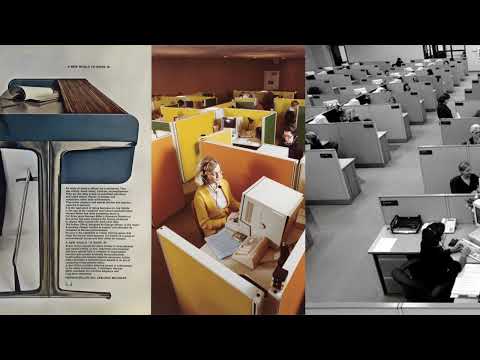
‘Reins, bridle, spurs, carrot, whip’: Labor Process Theory and Commercial Office Architecture
Post-event recording of a lecture delivered to the 2024 International Labor Process Conference held at the University of Göttingen.
-
 11/6/25
A discipline that sat on its treasures, but didn’t see them
Live recording of a paper delivered to the 2023 conference Researching a Rigged Game: Open Source Data & the Trade in Cultural objects, co-hosted by the University of Glasgow and University College London (UCL).
-
 • 11/4/25
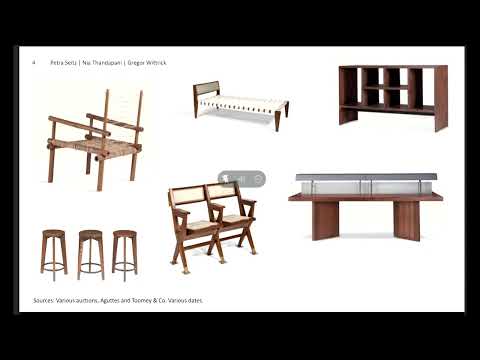
Chandigarh Chairs and Design History: What's the point?
Live recording of a 2022 talk delivered to the Bhopal School of Planning and Architecture.
-
 • 11/4/25
Chandigarh Chairs: Missing Histories
Live recording of a talk delivered in 2020 to the Bangalore International Centre, in collaboration with the Association of Designers of India (ADI).
-
• 11/4/25
Online Auction Data as Primary Material: The Chandigarh Chairs Auction Database
This is a live recording of a paper delivered to the Society of Architectural Historians Historic Interiors Affiliate Group 2022 conference, Digital Interiors.
-
 • 11/4/25
When good office designs go bad: Theory Y, Mid-century ideology, and the evolution of Herman Miller's Action Office
Live recording of a 2023 talk delivered to the Institute of Historical Research’s History Lab.
-
 • 11/4/25
The Office is Dead! Long Live the Office!: The Coronavirus Pandemic and the Future of Office Spaces
Live recording of a talk delivered to the 2021 Pandemic Perspectives Conference.
-
 • 11/4/25
Resistance is futile: Modernist chairs in Star Trek and beyond
Live recording of a paper delivered to Trinity College Dublin’s 2020 HistoryCon.